


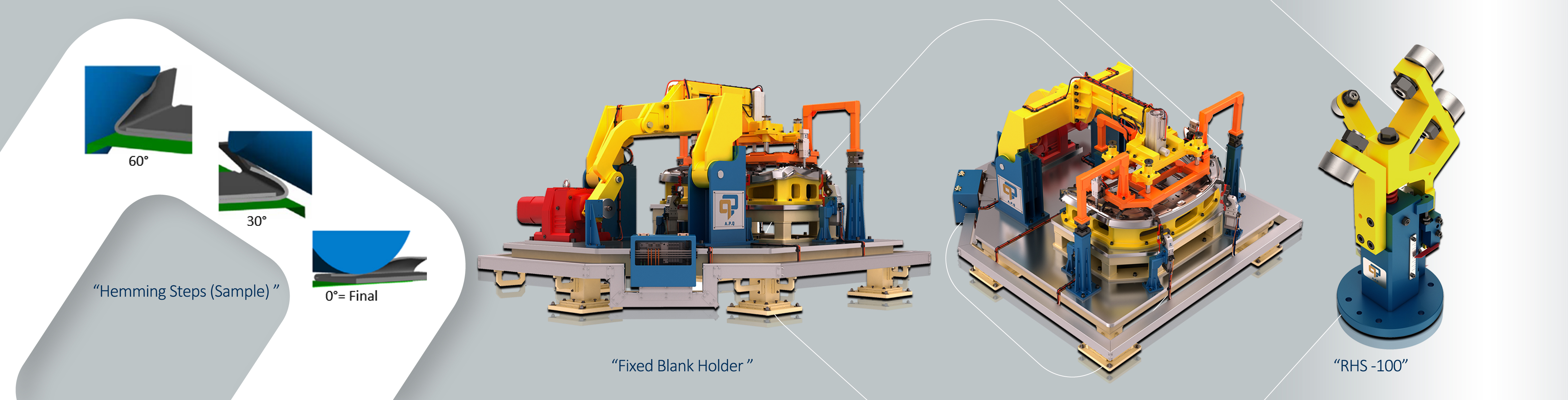
Roller Hemming System
Robotic Roller Hemming Systems – Engineering and Manufacturing
Hemming is a key manufacturing process in Body-in-White (BIW) production, joining outer and inner closure panels while preserving the dimensional accuracy and surface quality required for Class-A automotive components.
Applied to doors, hoods, deck lids, tailgates, and roof assemblies, the hemming process combines structural integrity with the surface appearance demanded by modern vehicle manufacturing.
APQ provides integrated engineering and manufacturing of robotic roller hemming systems, covering the complete project lifecycle from process development and digital validation to tooling manufacturing, installation, commissioning, and production support. More than twenty years of experience in closure manufacturing and the successful delivery of numerous robotic hemming projects provide the technical foundation for reliable, production-oriented solutions.
Process Engineering and Digital Development
Every hemming project begins with a comprehensive engineering evaluation of the product and manufacturing process before tooling design is initiated.
Using advanced engineering platforms including AutoForm, CATIA, and DELMIA, digital simulations are performed to validate process feasibility and optimize forming parameters prior to manufacturing.
Engineering activities include:
- Hemming feasibility analysis
- Flange design and optimization
- Hemming sequence development
- Roller path definition and validation
- Material flow analysis
- Crack and split prediction
- Wrinkle prevention analysis
- Springback compensation
- Cycle time optimization
- Robot accessibility studies
- Process validation
This simulation-driven approach minimizes technical risks while establishing stable and repeatable manufacturing conditions for both steel and aluminum closure panels.
Integration of Simulation and Tooling Engineering
A distinguishing feature of APQ's engineering methodology is the direct integration of digital simulation with physical tooling development.
Validated roller paths generated during the simulation stage are incorporated directly into tooling design through dedicated mechanical guiding features. This engineering concept enables robot trajectories to be established using predefined mechanical references rather than extensive manual teaching during commissioning.
As a result, more than 95% of the final robot trajectory can typically be achieved through validated engineering data before production startup.
This integrated methodology provides:
- Reduced robot teaching time
- Faster commissioning and production launch
- Reduced process tuning
- Improved process repeatability
- Stable hemming quality throughout production
- Reduced risk of Class-A surface defects
The close relationship between virtual engineering and physical tooling significantly shortens the transition from installation to stable serial production.
Robotic Roller Hemming Systems
APQ develops robotic roller hemming systems for a wide range of automotive closure applications.
Typical applications include:
- Front and rear doors
- Hoods
- Deck lids
- Tailgates
- Roof assemblies
Engineering solutions are developed for both steel and aluminum components and support manual, semi-automated, and fully automated production concepts where required.
System capabilities include:
- Robotic roller hemming cells
- Multi-model production
- Pre-hemming and final hemming operations
- High-precision robot path execution
- Automated process monitoring
- Process validation
Each project is engineered according to product geometry, production volume, automation level, and quality objectives.
Integrated Engineering and Manufacturing
APQ manages the complete lifecycle of hemming systems within a unified engineering organization.
The project scope includes:
- Process engineering
- Tooling design
- Digital validation
- Precision manufacturing
- Mechanical assembly
- Robot integration
- Tryout
- Commissioning
- Production support
The majority of tooling components are designed and manufactured under direct engineering control, ensuring consistency between digital development and physical implementation while minimizing dependency on external suppliers.
Manufacturing, Validation and Commissioning
Tooling systems are manufactured using precision machining technologies and verified through comprehensive quality assurance procedures.
Validation activities include:
- Mechanical assembly
- Dimensional inspection
- Metrology verification
- Functional testing
- Robot integration
- Process tryout
- Production validation
- On-site commissioning
During tryout and production launch, engineering teams work closely with customers to achieve dimensional targets, process capability requirements (CP/CPK), and specified production cycle times.
Production-Ready Hemming Systems
Successful hemming requires the integration of process engineering, digital simulation, tooling engineering, precision manufacturing, and production expertise.
By combining advanced engineering methods with practical manufacturing experience, APQ delivers robotic roller hemming systems designed to provide:
- Stable dimensional quality
- Repeatable production performance
- Reduced process variation
- Reliable long-term operation
- Efficient production ramp-up
The result is a fully validated hemming system engineered to meet the performance, quality, and productivity requirements of modern automotive manufacturing.