


Prototyping
Prototype Development
Validating Engineering Designs Before Production
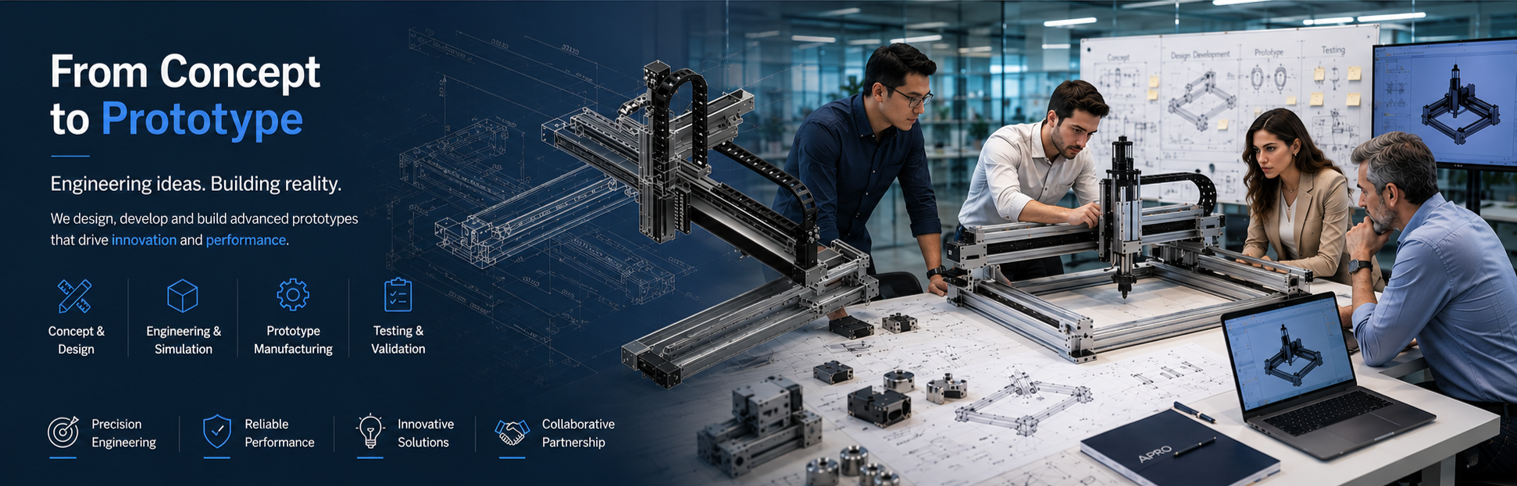
Prototype development is a critical stage in the product development process, providing the opportunity to verify engineering decisions under practical conditions before production resources are committed. Following product design and engineering, prototypes enable design concepts to be evaluated, refined, and validated through physical implementation and engineering assessment.
At APQ, prototype development is treated as an integral part of the engineering process rather than a standalone manufacturing activity. By combining digital engineering, practical fabrication methods, and systematic evaluation, we support the transition from engineered designs to production-ready product solutions while reducing technical uncertainty and development risk.
Our Prototype Development Process
1. Prototype Engineering Preparation
Prototype development begins with the preparation of engineering data derived from validated product designs. CAD models, engineering documentation, and technical specifications are reviewed and adapted to suit the selected prototype manufacturing process while preserving the intended functional and dimensional requirements.
This stage establishes a reliable foundation for prototype fabrication and subsequent engineering evaluation.
2. Prototype Manufacturing Planning
Before prototype fabrication begins, the most appropriate manufacturing strategy is selected according to the objectives of the prototype, the required level of validation, available manufacturing technologies, project schedule, and cost considerations.
Engineering activities at this stage typically include:
- Selection of prototype manufacturing methods
- Material selection
- Manufacturing feasibility assessment
- Evaluation of dimensional tolerances
- Assembly planning
- Cost and lead-time assessment
The objective is to ensure that prototype manufacturing supports engineering validation while remaining technically and economically practical.
3. Prototype Fabrication
Prototype components are manufactured using fabrication processes appropriate to the project's technical objectives. Depending on product requirements, prototype manufacturing may include:
- CNC machining for high-precision functional components
- Additive manufacturing for rapid design iteration and form verification
- Sheet metal fabrication and forming processes for structural evaluation
- Temporary stamping dies for automotive body panels and exterior components
Temporary stamping dies are used during automotive prototype development to manufacture body panels that closely represent the geometry, fit, and assembly characteristics of production parts. These tools support engineering validation and design refinement and are not intended for serial production.
4. Assembly and System Integration
Prototype components are assembled to evaluate dimensional accuracy, interface compatibility, assembly sequences, and overall system integration.
This stage helps identify assembly-related issues and confirms that individual components function together as intended before further validation activities begin.
5. Prototype Validation and Engineering Evaluation
Physical prototypes provide an opportunity to evaluate engineering assumptions under realistic conditions before production tooling is developed.
Validation activities may include:
- Functional verification
- Dimensional verification
- Assembly validation
- Structural assessment
- Evaluation of manufacturability
- Identification of design improvements
The results obtained during this stage provide valuable engineering feedback that supports informed design decisions and further product refinement.
6. Iterative Design Improvement
Prototype development is an iterative engineering process. Information gathered during fabrication, assembly, and validation is systematically incorporated into subsequent design revisions, allowing engineering solutions to mature progressively before production planning begins.
This continuous improvement process helps reduce development risk while increasing confidence in the final product design.
Role in Product Development
Within the overall product development process, prototype development provides the essential link between digital engineering and production planning.
By validating engineering decisions through physical implementation, prototypes help verify product performance, identify opportunities for design improvement, and reduce the technical and manufacturing risks associated with production readiness.
Outcome
Prototype development provides a structured engineering environment for validating product designs before production. By combining practical manufacturing methods, engineering evaluation, and iterative design improvement, organizations can reduce technical uncertainty, improve manufacturability, strengthen engineering confidence, and establish a more reliable foundation for production planning and industrialization.