


ROBOTICS
Engineering Robotic Systems for Modern Manufacturing
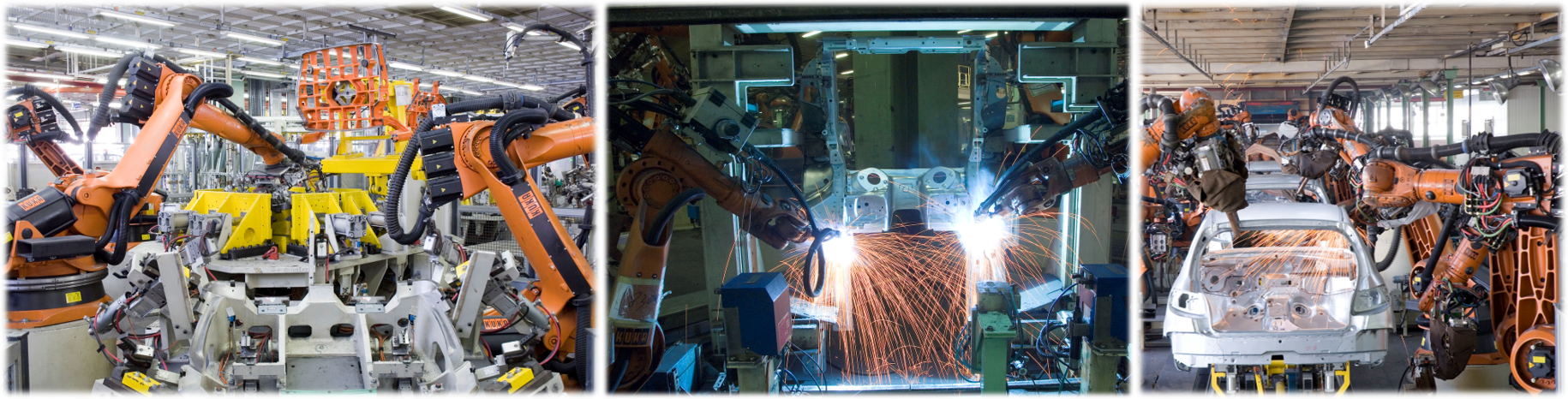
Industrial robotics has become a core enabler of modern manufacturing, supporting higher productivity, improved process stability, consistent quality, and greater operational flexibility across a wide range of industries. As production environments continue to evolve, manufacturers increasingly require robotic solutions that are not only reliable in execution, but also fully integrated into the broader production system.
Within this context, robotics is no longer limited to standalone robot programming or isolated applications. It is a system-level engineering discipline that combines mechanical design, control systems, process understanding, simulation, tooling, and commissioning into a unified industrial solution.
Cross-Industry Engineering Experience
APQ develops robotic systems for diverse industrial applications, ranging from high-volume manufacturing to complex, high-precision production environments. While extensive experience has been gained in demanding automotive body shop automation projects, the engineering principles and integration methods applied in these projects are fundamentally transferable across industries.
This includes applications in general manufacturing, metal processing, machinery production, consumer goods, and other industrial sectors where precision, reliability, and repeatability are essential.
Rather than being limited to a single industry, our robotics engineering approach is based on scalable methodologies that can be adapted to different production requirements and operational constraints.
Robotics as an Integrated Engineering System
A successful robotic solution requires more than the robot itself. It depends on the coordinated design and integration of multiple engineering domains working as a single system.
These typically include:
- Robotic simulation and offline validation
- End-of-Arm Tooling (EOAT) design and manufacturing
- Mechanical design and fixture integration
- Control system and process integration
- Safety system design
- Installation and commissioning
- Production ramp-up and optimization
By integrating these disciplines within a unified engineering framework, robotic systems are developed with a clear focus on real production performance rather than isolated technical functions.
Our Robotics Engineering Scope
Robotic projects are supported across the full lifecycle of development and implementation, from early concept studies to stable production operation.
Core engineering capabilities include:
- Robotic cell concept development and application engineering
- 3D simulation and offline programming
- Cycle time analysis, reachability and feasibility studies
- Custom gripper and EOAT design and manufacturing
- Robot selection and platform integration
- Robotic cell installation and system integration
- Programming, commissioning and process optimization
- Production support and continuous improvement
This lifecycle-based approach ensures that engineering decisions remain aligned with real manufacturing requirements throughout implementation and operation.
Robotic Simulation and Virtual Validation
Simulation plays a critical role in reducing project risk and improving engineering accuracy.
Through advanced robotic simulation environments, production concepts can be evaluated before physical implementation. This includes verification of robot reachability, cycle time performance, workstation layout, collision detection, and process feasibility.
Virtual validation enables engineering teams to identify and resolve potential issues at an early stage, improving implementation efficiency and reducing commissioning effort.
Custom Gripper and EOAT Engineering
End-of-Arm Tooling is a critical component of any robotic system, directly influencing performance, cycle time, and process reliability.
Our engineering teams design and manufacture custom EOAT solutions tailored to specific process requirements such as welding, assembly, material handling, inspection, and specialized production operations.
Design considerations include mechanical integrity, process accessibility, maintainability, safety, and long-term operational stability within real production environments.
Multi-Platform Robotic Integration
Our engineering teams have experience working with leading industrial robot platforms, enabling flexible integration based on technical requirements rather than vendor constraints.
This includes systems from major global robot manufacturers, allowing selection of the most suitable solution for each application based on performance, process compatibility, and lifecycle considerations.
The result is a technology-neutral approach focused on production performance and system reliability.
From Concept to Production
One of the key strengths of an integrated robotics engineering approach is continuity throughout the entire project lifecycle.
From initial concept development and simulation to mechanical design, integration, commissioning, and production support, all project phases are connected within a single engineering workflow.
This continuity ensures that engineering decisions remain consistent with real production conditions, reducing technical risk and improving long-term operational stability.
Robotics Engineering Philosophy
The objective of our robotics engineering approach is not simply to deploy robots, but to deliver complete production systems that operate reliably within real industrial environments.
By combining simulation, mechanical engineering, control integration, tooling design, and commissioning expertise, we develop robotic solutions that support productivity, process stability, product quality, and operational efficiency.
This methodology is applicable across a wide range of industries and production environments where automation and robotics play a key role in manufacturing performance.
Explore Our Robotics Capabilities
Detailed information about robotic simulation, EOAT engineering, robot programming, system integration, installation, and commissioning is provided in the dedicated sections of this website.
Whether developing a new robotic production system or optimizing an existing installation, our engineering team supports the full lifecycle of industrial robotics projects from concept to stable operation.