


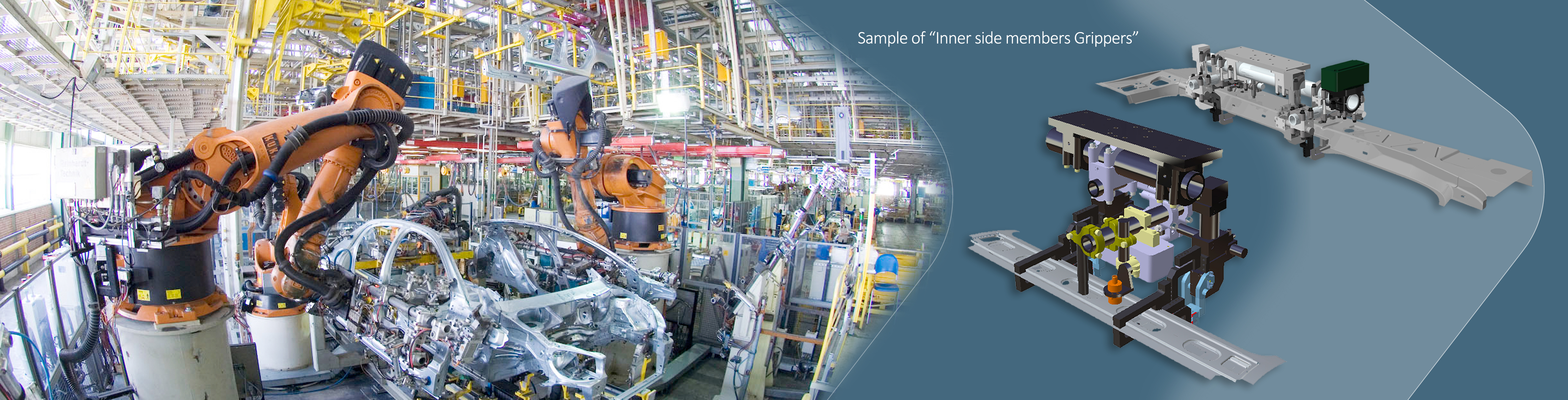
Grippers
Robotic Grippers & End-of-Arm Tooling (EOAT)
Engineering the Critical Interface Between Robots and Manufacturing Processes
End-of-Arm Tooling (EOAT) is one of the most important elements of any robotic system. Positioned at the interface between the robot and the manufacturing process, it directly influences process reliability, product quality, production efficiency, and overall system performance.
While industrial robots provide the motion and positioning capabilities required for automated manufacturing, the EOAT determines how components are handled, positioned, processed, or manipulated throughout the production cycle. The performance of the entire robotic system therefore depends not only on the robot itself, but also on the engineering quality of the tooling attached to it.
APQ designs and develops custom robotic grippers and EOAT solutions for a wide range of industrial applications. Drawing upon practical experience gained through complex automation projects—including demanding automotive manufacturing environments—our engineering methodologies are equally applicable to diverse industries where reliable and efficient robotic automation is required.
EOAT Engineering for Industrial Automation
Every manufacturing process presents unique technical challenges. Differences in product geometry, material characteristics, production rates, robot payload, accessibility, and process requirements demand tooling solutions specifically engineered for each application.
Rather than relying on standardized designs, EOAT systems are developed to support the functional requirements of the production process while maintaining reliability, maintainability, and long-term operational performance.
Engineering activities include mechanical design, structural evaluation, actuator selection, integration with robotic cells, and coordination with automation and manufacturing requirements throughout the project lifecycle.
Why EOAT Design Matters
The effectiveness of a robotic system is determined by the combined performance of the robot, the tooling, and the manufacturing process.
A properly engineered EOAT contributes to:
- Accurate and repeatable part handling
- Stable and reliable manufacturing processes
- Reduced production cycle times
- Improved operational efficiency
- Enhanced workplace safety
- Increased equipment durability and maintainability
By considering both engineering requirements and production objectives from the earliest stages of development, tooling solutions can be optimized for reliable operation under real manufacturing conditions.
Engineering Considerations
Successful EOAT development requires a multidisciplinary engineering approach that extends beyond mechanical design alone.
Each solution is developed by considering factors such as:
- Product geometry and workpiece characteristics
- Robot payload and dynamic performance
- Accessibility and workspace constraints
- Structural rigidity and weight optimization
- Pneumatic and electromechanical actuation
- Maintenance accessibility
- Process safety requirements
- Production cycle time objectives
Balancing these engineering considerations helps ensure that tooling performs consistently while supporting long-term production reliability.
Engineering Capabilities
Engineering services are provided throughout the complete development process of robotic grippers and EOAT systems.
Core capabilities include:
- Custom robotic gripper design
- End-of-Arm Tooling (EOAT) engineering
- Mechanical design and structural analysis
- Pneumatic and electromechanical system design
- Integration with robotic cells and production equipment
- Manufacturing support
- Installation assistance and commissioning support
Each project is developed with a practical engineering approach focused on functionality, reliability, maintainability, and integration within the overall production system.
Application-Oriented EOAT Solutions
EOAT systems are developed according to the functional requirements of each manufacturing application.
1. Handling Grippers
Handling grippers are designed for picking, transferring, loading, unloading, and positioning components throughout manufacturing and logistics operations.
These solutions are widely applied in automated production environments requiring reliable and repeatable material handling.
Typical applications include:
- Material handling
- Loading and unloading operations
- Assembly processes
- Packaging and logistics systems
2. Geometrical Grippers (Geo Grippers)
Geo Grippers combine handling functionality with accurate positioning and clamping of workpieces during manufacturing operations.
In many applications they function as mobile fixtures, integrating positioning, locating, and clamping mechanisms directly into the robotic tooling.
Typical applications include:
- Robotic welding
- Forming operations
- Hemming processes
- Assembly applications
- Inspection stations
3. Fixture-Based Robotic Tooling
Certain manufacturing processes require fixture functions to move together with the robot rather than remain fixed within the production cell.
In these applications, the robotic tooling becomes an integral part of the manufacturing process, enabling controlled positioning, improved accessibility, and greater production flexibility while maintaining process accuracy and repeatability.
Applications Across Multiple Industries
Although extensive experience has been developed through automotive manufacturing and Body Shop automation projects, the engineering principles applied in EOAT development are transferable across numerous industrial sectors.
Custom tooling solutions can be engineered for applications involving material handling, assembly, packaging, machine tending, inspection, testing, logistics, and other automated manufacturing processes.
Each solution is developed according to the technical and operational requirements of the specific production environment rather than being limited to a particular industry.
An Integrated Engineering Approach
Successful EOAT development requires the integration of robotics, mechanical engineering, automation, manufacturing processes, and practical production knowledge.
By combining these disciplines within a structured engineering framework, tooling solutions are developed that not only perform their intended function but also contribute to the overall stability, efficiency, and reliability of the complete robotic system.
The objective is not simply to design a gripper, but to engineer tooling solutions that support consistent manufacturing performance throughout the operational life of the production system.