


Tooling
BIW Tooling Engineering and Manufacturing
BIW tooling defines the dimensional foundation of automotive body assembly. It is the interface between product geometry and production reality, ensuring that stamped components are located, assembled, and validated within controlled dimensional tolerances throughout the manufacturing process.
APQ provides integrated engineering and manufacturing of BIW tooling systems, covering both the design and fabrication of complete fixture solutions for automotive production lines. With more than two decades of experience in Body-in-White environments, our team delivers tooling systems developed for industrial robustness, repeatability, and long-term production stability.
Scope of BIW Tooling Systems
The engineering and manufacturing scope covers all major categories of BIW fixtures and assembly stations:
- Geo Fixtures – primary locating systems establishing the dimensional reference of BIW assemblies
- Re-Spot Fixtures – secondary welding fixtures ensuring structural reinforcement and weld completion
- Framing Fixtures – large-scale systems defining final body geometry
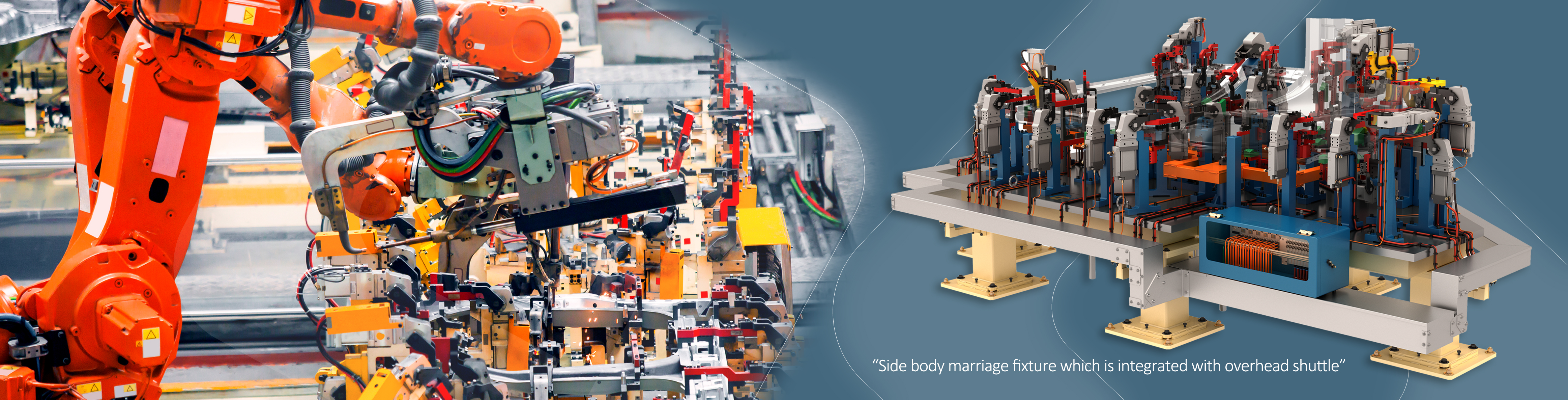
- Marriage Fixtures – stations for precise assembly of major body modules
- Checking Fixtures – dimensional verification systems for product validation and quality control
These systems are applied across all BIW domains, including:
- Front and rear underbody structures
- Side body assemblies
- Roof structures
- Floor systems
- Closure systems
- Structural sub-assemblies
- Framing and integration stations
Each tooling system is engineered to ensure dimensional stability, process repeatability, and compatibility with automated or manual production environments.
Integrated Design and Manufacturing Capability
A defining characteristic of APQ is the integration of tooling design and tooling manufacturing within a single engineering organization.
This approach ensures full continuity between:
- Product and process requirements
- Fixture design and assembly sequence
- Manufacturing feasibility and shop-floor constraints
- Installation and commissioning requirements
- Long-term production performance
Tooling solutions are not only designed but also manufactured, assembled, and validated under coordinated engineering control, ensuring alignment between digital definition and physical execution.
Engineering Based on Production Reality
Tooling design is driven by direct experience in BIW production environments.
Engineering decisions are based on real manufacturing constraints, including:
- Robot accessibility and reachability
- Cycle time and takt time requirements
- Maintenance and service accessibility
- Structural rigidity and deflection control
- Production uptime and reliability considerations
This production-oriented approach ensures that tooling systems are optimized not only for dimensional accuracy, but also for operational efficiency and long-term industrial performance.
Digital Engineering and Validation
All tooling systems are developed and validated using advanced digital engineering platforms, including CATIA and DELMIA.
Digital engineering activities include:
- 3D design and digital mock-up (DMU) validation
- Reference Point System (RPS) definition and verification
- GD&T-based tolerance definition and analysis
- Process and assembly simulation
- Reachability and accessibility studies
- Tolerance stack-up evaluation
This digital-first methodology ensures that dimensional behavior, assembly feasibility, and process constraints are validated prior to physical manufacturing.
Manufacturing and Quality Control
Tooling manufacturing is executed through a controlled industrial network with precision machining and assembly capabilities.
Quality assurance activities include:
- Precision machining and fixture assembly
- Dimensional inspection and metrology validation
- Functional testing and operational verification
- Pre-shipment validation (Buy-Off)
Each tooling system is verified against validated digital models and project-specific dimensional requirements before delivery.
Project Lifecycle Execution
APQ supports the complete lifecycle of BIW tooling projects:
- Concept development
- Detailed 3D engineering
- Digital validation
- Manufacturing and machining
- Assembly and integration
- Installation at customer site
- Commissioning and tryout
- Production support and optimization
During commissioning and tryout phases, engineering teams work jointly with customers to achieve dimensional targets, process capability requirements (CP/CPK), and defined production cycle times.
Production-Oriented Tooling Performance
BIW tooling systems are developed to ensure:
- Controlled dimensional variation
- Stable and repeatable assembly conditions
- Reduced scrap and rework rates
- High uptime in production environments
- Consistent vehicle quality performance
The objective is to provide tooling systems that are fully aligned with modern automotive manufacturing requirements, supporting efficient ramp-up and stable long-term production.