


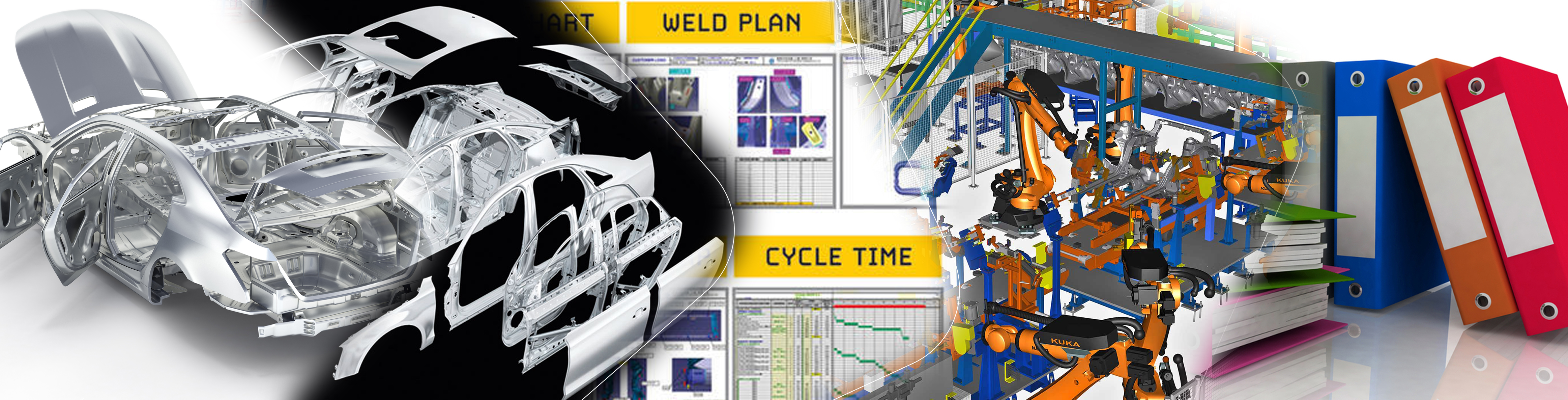
Process Engineering
Process Engineering – BIW Assembly Systems
A production process is not a simple sequence of operations, but an integrated system that connects product design, manufacturing technology, production capacity, quality requirements, and operational performance.
At the core of APQ’s automotive expertise is Body-in-White (BIW) assembly process engineering. With more than two decades of project experience in automotive manufacturing, our team develops production processes that translate vehicle designs into robust, efficient, and production-ready assembly systems.
The objective is to ensure that each joining operation, each workstation, and each process step contributes to achieving defined targets for quality, dimensional accuracy, and productivity.
BIW Assembly Engineering Expertise
BIW process engineering represents the foundation of our automotive activities.
Our experience covers a wide range of vehicle programs and BIW structures, including:
- Front and rear underbody structures
- Side frame assemblies
- Roof structures
- Floor systems
- Closure systems
- Structural sub-assemblies
- Geo stations
- Re-spot stations
- Marriage stations
- Framing stations
This project experience provides a detailed understanding of both individual assembly operations and the geometric relationships that define final vehicle quality.
Product-Driven Process Development
Manufacturing performance is defined long before production begins.
During early New Product Development (NPD), our process engineers work closely with product engineering teams to ensure manufacturability is considered from the outset, applying Design for Manufacturability (DFM) principles.
Key activities include:
- CAD data review and manufacturability assessment
- Assembly sequence definition (part tree development)
- Spot welding and joining strategy definition
- Geometrical reference system definition
- Assembly feasibility analysis
- Tolerance stack-up analysis
- Locating and clamping strategy development
Early identification of manufacturing constraints helps reduce engineering changes, shorten ramp-up phases, and improve overall product robustness.
Line-Specific Process Engineering
Each production facility is defined by its own constraints, targets, and automation level.
Depending on project requirements, we develop concepts for manual, semi-automated, or fully automated BIW assembly lines.
Our scope includes:
- Station-by-station process planning (SOS development)
- Capacity planning and line balancing
- Cycle time analysis and optimization
- Bottleneck identification and resolution
- Equipment selection and specification
- Robot allocation and process distribution
- Material flow analysis
- Layout development and optimization
- Manpower planning
- Ergonomic assessment
- Production readiness evaluation
The outcome is a production system designed to meet volume requirements while maintaining efficiency, quality stability, and operational flexibility.
Digital Engineering and Process Simulation
Virtual validation is an essential step in modern manufacturing development.
Using tools such as CATIA and DELMIA, production concepts are developed and validated in a digital environment prior to implementation.
This includes:
- Process simulation
- Robot reach and accessibility studies
- Ergonomic validation
- Cycle time verification
- Production flow analysis
- Layout validation
- Manufacturing feasibility checks
Digital validation reduces project risk and improves execution reliability during installation and ramp-up.
Integrated Process and Tooling Engineering
A key advantage of APQ is the integration of process engineering and tooling engineering within a single organization.
This enables direct alignment between:
- Process definition
- Assembly sequence
- Fixture and tooling design
- Automation concepts
- Quality requirements
- Production targets
This integrated approach reduces interface complexity, minimizes redesign cycles, and improves overall project execution efficiency.
Delivering Production-Ready BIW Systems
A successful vehicle program requires more than equipment installation; it requires a fully defined and validated production process.
Our process engineering services support automotive manufacturers in developing efficient, scalable, and reliable BIW assembly systems.
From early concept development and digital validation to production launch and process optimization, APQ provides the engineering foundation required to transform vehicle designs into stable manufacturing operations.